
The Gambia Launches Education Data Center to Publicly Share Education Data
The Ministry of Basic and Secondary Education has integrated education data from separate sources onto a single public DHIS2 portal, the Education Data Center, and is now building new applications on top of it, including an early warning system to identify learners at risk of dropping out.
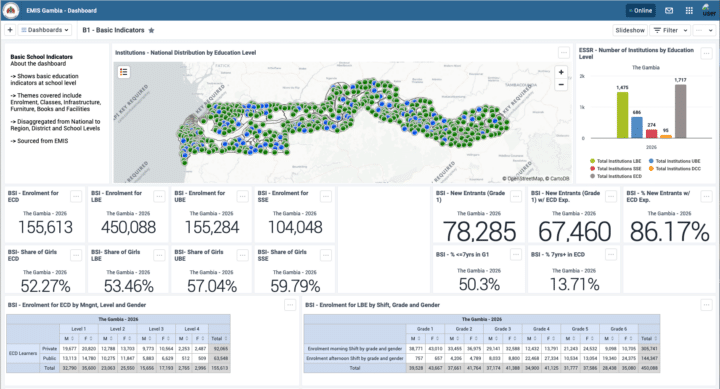
The Ministry of Basic and Secondary Education (MoBSE) in The Gambia has launched its Education Data Center, a live, interactive DHIS2-based portal open to anyone with a browser. It consolidates sources that were previously held separately into a single repository, giving ministry staff one point of access for planning, monitoring and reporting.
Since 2014, the ministry has published the country’s education data in its Statistical Yearbook, a large document compiled from questionnaires collected at schools in November and published the following May. The yearbook has been the main source of data for anyone who wanted to know how many children were enrolled, where classrooms were short or how completion rates differed by region. The portal was built to make that data available more quickly, and it has since become a base for new tools the ministry is building on top of the data it already holds.
Because the portal is public, it also changes who can examine the data. Researchers, journalists, civil society organizations and head teachers no longer have to wait for the annual publication, or work through the ministry, to get answers to their own questions.
Building on an education data system that was already in place
The MoBSE began implementing a DHIS2-based education management information system (EMIS) in 2018, building on a platform the country had already been using as its national health information system since 2009. Over the following years, the ministry added daily attendance reporting, individual-level learner records and dashboards for regional planning teams.
What the ministry did not yet have, however, was a single place where all of it came together. The annual school census, attendance reporting and other collection processes each produced data, but combining them meant working across systems. The Education Data Centre consolidates those sources into one repository, which now makes it possible for education leaders to view attendance patterns set against performance and other variables.
The portal is used in addition to the Statistical Yearbook—not as a replacement for the annual document, which Permanent Secretary Louis Moses Mendy described as “the cornerstone for basic education statistics.” What the portal changes is what data is available in the 11 months between one yearbook and the next.
MoBSE built the portal as part of the Global Partnership for Education Knowledge and Innovation Exchange (GPE KIX) project “Empowering Districts and Schools with Data,” which is coordinated by the HISP Centre at the University of Oslo and implemented with local partner HISP West and Central Africa. Throughout the project, ministry staff have communicated with other countries implementing DHIS2 for Education, adapting approaches developed elsewhere in the network to the Gambian context.
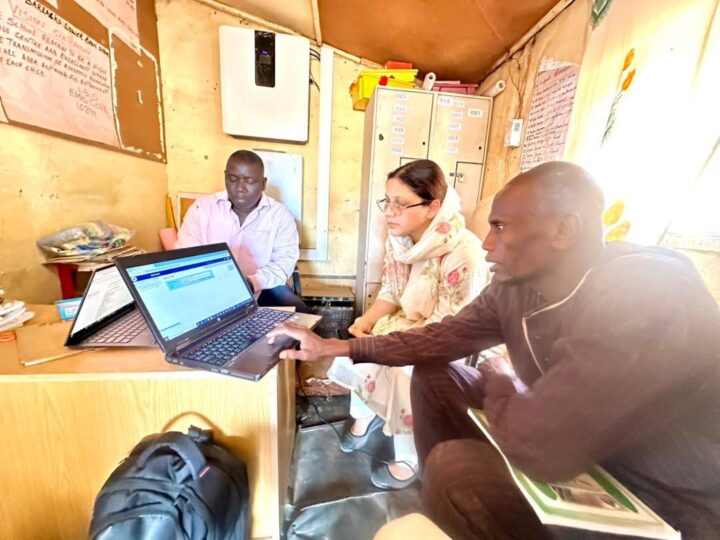
Public access changes who can analyze the data
The portal was built for the ministry’s own planning and monitoring, but it is public by design. IIn her preface to the 2026 Statistical Yearbook, Habibatou Drammeh, Minister of Basic and Secondary Education, wrote that “data is the spark that ignites meaningful progress,” and called on senior management, school leaders, development partners and the Gambian public to “dive into these statistics with enthusiasm.”
A document that is published annually provides only a snapshot in time and naturally limits who may access the data, but a public portal makes it possible for any researcher, journalist, civil society organization or head teacher to search the data for answers to their questions. It also shifts what the ministry is publishing—not a finished set of conclusions about the education sector, but the underlying figures themselves, available to be examined by everyone.
Next steps for the portal
Since the Education Data Center became operational, the ministry has started using it as a base for tools that go beyond reporting, commissioning additional applications to be built on top, including an early warning system to identify learners at risk of dropping out. Work has also started on bringing teacher and learner assessment onto the same platform. Both proposed applications will build on data and infrastructure that already exist rather than requiring new systems, which is part of what makes them feasible for the ministry to pursue.
The Gambia is one of six countries now taking part in the GPE KIX project, alongside implementations elsewhere in the DHIS2 for Education network. The Gambian experience illustrates a common pattern—once education data is consolidated and accessible, ministries tend to find the next problem they want to solve. For the MoBSE, that problem is currently learner retention.